
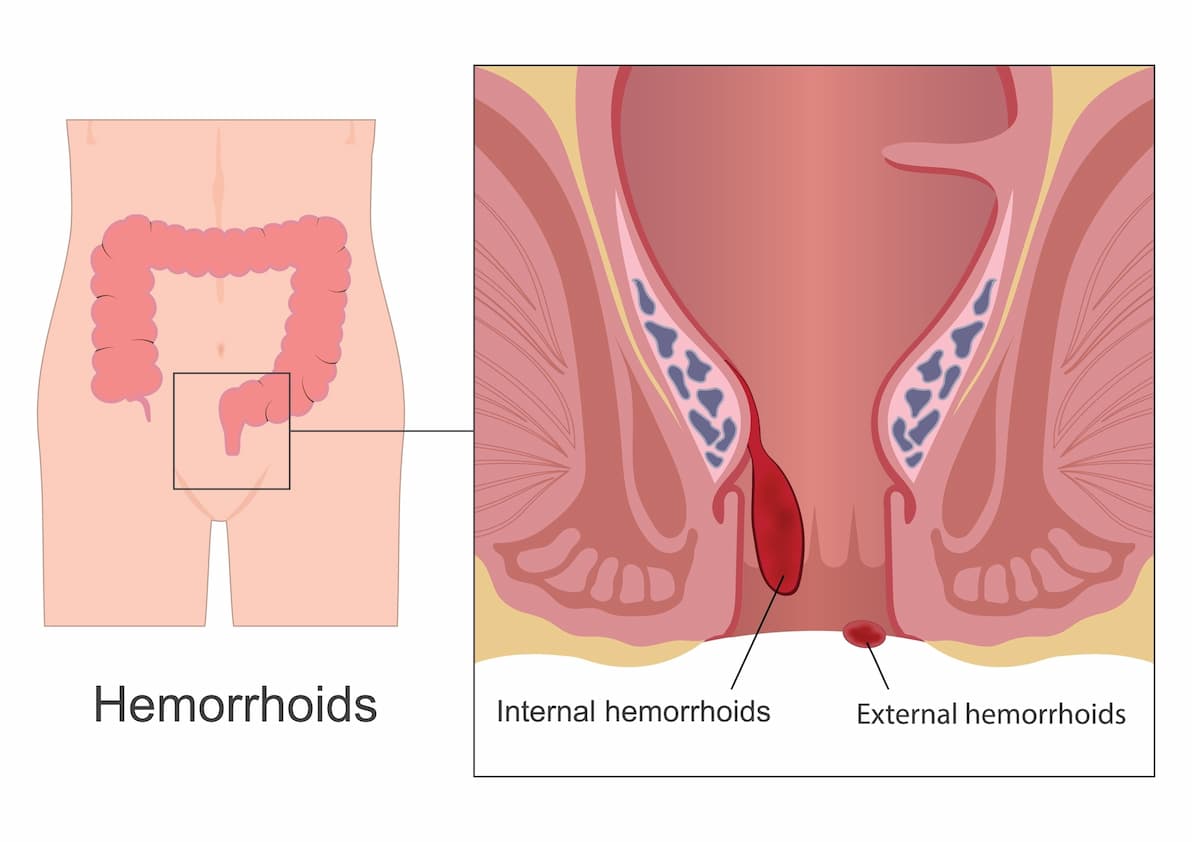
What Are Hemorrhoids?
Everyone has small cushions of blood vessels in the anal canal that help control bowel movements. Hemorrhoids happen when these cushions become swollen and enlarged. When that occurs they can bleed, itch, ache or slip down out of place.
Piles are one of the most common reasons people see a general surgeon for a bowel complaint. They become more likely with straining, constipation, pregnancy, long periods of sitting and increasing age. Many cases are mild and short lived, but some need treatment to settle properly.
Hemorrhoids vs Piles: Are They the Same Thing?
Yes. Piles is simply the everyday word for the same condition doctors call haemorrhoids. There is no medical difference between the two terms. You may hear either used during your consultation.
Types of Hemorrhoids
Internal Hemorrhoids
External Hemorrhoids
These sit under the skin around the anus and can often be felt as a lump. They are more likely to be sore or itchy, and can become quite painful if a small blood clot forms inside one, known as a thrombosed pile.
Internal vs External Hemorrhoids
| Feature | Internal | External |
|---|---|---|
| Location | Inside the rectum, above the anal opening | Under the skin around the anus |
| Pain | Usually painless | Can be painful, especially if clotted |
| Bleeding | Bright red bleeding is common | Bleeding is less common |
| What you notice | Fullness, or a lump that prolapses | A lump or swelling you can feel |
Hemorrhoid Grades (Stages)
- Grade 1: small, stay inside, may bleed
- Grade 2: prolapse when straining, then slip back on their own
- Grade 3: prolapse and need to be pushed back by hand
- Grade 4: stay prolapsed and cannot be pushed back
Consult Our Specialists to check your Hemorrhoid Grades
Symptoms of Hemorrhoids
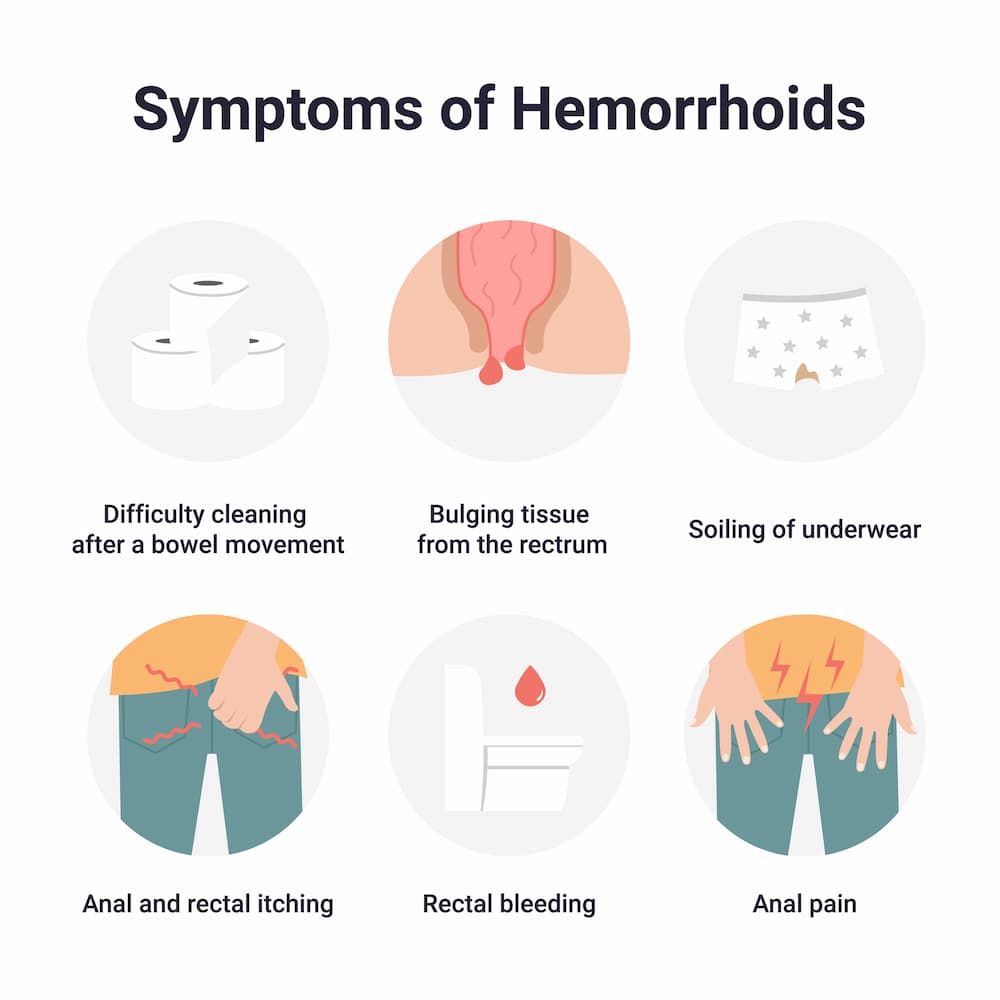
Symptoms depend on the type of pile, and some people have no symptoms at all. The common signs to look out for are:
- Bright red bleeding during or after a bowel movement, usually painless
- Itching or irritation around the anus
- A soft lump or swelling at the edge of the anus
- A bulge of tissue that comes down from the back passage, known as a prolapse
- Discomfort, soreness or aching in the anal area
- Mucus discharge or soiling of the underwear
- Difficulty cleaning after a bowel movement
What Do Hemorrhoids Look Like?
External piles often appear as one or more soft lumps or swellings at the edge of the anus. A clotted one can look bluish or purple and feel firm. Internal piles usually cannot be seen from the outside unless they have prolapsed.
Bleeding Hemorrhoids
When to get bleeding checked: See a doctor about any rectal bleeding, particularly if the blood is dark, mixed through the stool, or comes with a change in bowel habit, weight loss or new symptoms after the age of 40. Piles are a common cause of bleeding, but not the only one, so it is worth confirming. See our related guide on blood in stools.
Symptoms in Women
Symptoms are much the same as in men. Women are more prone to piles during pregnancy and after childbirth, when extra pressure in the pelvis and straining make them more likely. These often improve after delivery.
Symptoms in Men
What Causes Hemorrhoids?
Piles develop when there is repeated or increased pressure on the veins around the anus. Common contributors include:
- Constipation, hard stools and straining on the toilet
- A diet low in fibre
- Sitting for long periods, including long spells on the toilet
- Pregnancy and childbirth
- Carrying extra weight
- Heavy lifting
- Ageing, as the supporting tissue weakens over time
- Ongoing diarrhoea
How to Treat Hemorrhoids
| Approach | What it involves | Usually suited to |
|---|---|---|
| Care at home | More fibre and fluids, warm baths, not straining, not sitting long on the toilet | Mild or first flare-ups |
| Pharmacy relief | Creams, ointments, suppositories, stool softeners, simple pain relief | Easing symptoms while piles settle |
| Clinic procedures | Rubber band ligation, injection (sclerotherapy) or infrared coagulation, done in minutes without general anaesthetic | Internal piles that bleed or prolapse, roughly grades 1 to 3 |
| Surgery | Removal (haemorrhoidectomy), stapling, or an artery ligation procedure under anaesthetic | Large, prolapsed or persistent piles, roughly grades 3 to 4 |
Home Remedies for Piles
Medication for Hemorrhoids
Treating Piles Without Surgery
Many piles are treated in the clinic without surgery. Rubber band ligation places a tiny band at the base of an internal pile so it shrinks and drops off. Sclerotherapy injects a solution to close it off, and infrared coagulation uses heat to do the same. These take only minutes and most people return to normal activities quickly.
Treating External Hemorrhoids
External piles usually settle with the measures above over a week or two. A painful thrombosed one may be relieved by a minor procedure to release the clot, which works best within the first day or two of the pain starting.
Treating Internal Hemorrhoids
Relieving Hemorrhoid Pain
Treating Bleeding Pile
When to See a Doctor, and Can Piles Be Cured?
See a general surgeon if you have bleeding, ongoing pain, a pile that will not go back in, symptoms that do not improve within a week or two, or piles that keep coming back. Getting checked also rules out other causes of the same symptoms.
Mild piles often clear up with simple measures. When treatment is needed, clinic procedures and surgery are effective at settling problem piles for good. New ones can still form later if the habits that caused them continue, which is why the changes under prevention matter.
How to Prevent Hemorrhoids
- Eat plenty of fibre from fruit, vegetables and wholegrains
- Drink enough water through the day
- Avoid straining and do not sit on the toilet longer than needed
- Stay active and keep to a healthy weight
- Go when you need to rather than holding on
- Treat constipation early before stools harden

Hemorrhoids are treated as part of our general surgery service. Dr Julian Wong and Dr Tang Tjun Yip are Senior Vascular and General Surgeons, both dual accredited in the UK and Singapore and registered with the Singapore Medical Council and the General Medical Council. Between them they hold close to 50 years of surgical experience. Dr Wong trained and practised as a Consultant General and Vascular Surgeon in the NHS in the UK before returning to Singapore, and previously headed a hospital surgical division here. He also serves as an examiner for the Royal Colleges of Surgeons and as Chief Examiner for the MRCS.
Frequently Asked Questions
Can you push hemorrhoids back in?
Do piles go away on their own?
Can hemorrhoids cause mucus discharge?
Can piles cause stomach pain?
Why do hemorrhoids make me feel like I need to go?
Are bleeding piles dangerous?
Do I need surgery for piles?
How long do piles last?
References
10. NHS. Piles (Haemorrhoids). nhs.uk/conditions/piles-haemorrhoids
11. Mayo Clinic. Hemorrhoids.
https://www.mayoclinic.org/diseases-conditions/hemorrhoids/symptoms-causes/syc-20360268
12. Cleveland Clinic. Hemorrhoids. my.clevelandclinic.org/health/diseases/15120-hemorrhoids
13. Johns Hopkins Medicine. Hemorrhoids.
hopkinsmedicine.org/health/conditions-and-diseases/hemorrhoids